

Shine On
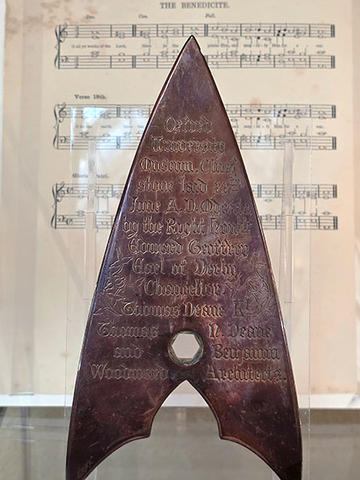
The foundation stone of the Museum was laid on 20 June 1855 in a ceremony attended by many of the leading figures of the University and the city of Oxford. The Chancellor, Lord Derby, set the stone using the specially commissioned trowel displayed here. It was made by Francis Skidmore of Coventry, who was also responsible for the Museum’s celebrated iron and glass roof.
The trowel was carried in procession by William and Sarah Acland, the eldest children of Dr Henry Acland, Regius Professor of Medicine and one of the Museum’s principal founders. The ceremony included the Benedicite, Omnia Opera, and a special prayer composed by Acland for the occasion.
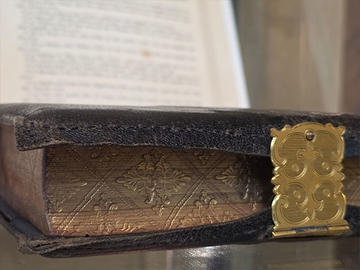
The Bible displayed alongside the trowel was presented, “in love to his young friend”, Sarah Acland by one of the Museum’s architects, Sir Thomas Deane, on the day of the ceremony. On the Museum’s jubilee, following a Convocation ceremony in the Sheldonian Theatre on 8 October 1908, Sarah Acland donated the Bible to the Museum’s Archive, where it has remained ever since.

Sir William Schwenck Gilbert (1836-1911) was an English dramatist, librettist, poet and illustrator best known for his creative partnership with composer Arthur Sullivan. Together they produced fourteen comic operas including H.M.S. Pinafore, The Pirates of Penzance, and The Mikado, one of the most frequently performed works in the history of musical theatre.
Gilbert was a close friend of Henry Rowland-Brown, an English entomologist who specialised in Lepidoptera, the study of butterflies and moths. Although trained in law and employed as a journalist, Rowland-Brown remained a dedicated entomologist and a regular visitor to the Museum’s entomological department. It was through Rowland-Brown, who was gifted the microscope in 1911, that Gilbert’s microscope was eventually donated to the Museum for use in the department. However as scientific technology advanced, the microscope was gradually replaced by more modern equipment.
Today, Gilbert’s beautiful brass microscope is displayed in the Museum’s Library and Archive, where it serves as a reminder of both its distinguished owner and the close connections between science, collecting and culture. Appropriately the label acknowledges its original owner Sir W. S. Gilbert, the “Very Model of a Modern Microscopist.”
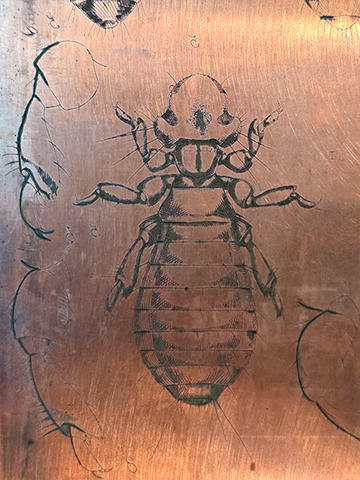
Henry Denny (1803-1871) was an English entomologist and the first curator of the Leeds Philosophical Society Museum. A passionate collector of all types of animal specimens, he developed a particular fascination with lice and became one of the world’s leading authorities on the order Phthiraptera.
The Denny Collection comprises more than 3,000 lice specimens gathered from researchers across the globe, including his good friend Charles Darwin, who collected lice for Denny during the HMS Beagle voyage. Alongside the specimens, the collection contains Denny’s archive of research papers and notes, as well as an incomplete and unpublished monograph on exotic lice species, intended as a follow up to his 1842 book on the sucking lice of the British Isles. Among the archive’s highlight is the original copper plates used to print the illustrations, which were then individually hand-painted by Denny himself.
The Denny Collection was purchased for the Museum after Denny’s death and remains an important resource for the study of parasitic insects. And while lice may not seem like the most glamorous of entomological specimens, in copper plate form they have never looked better!
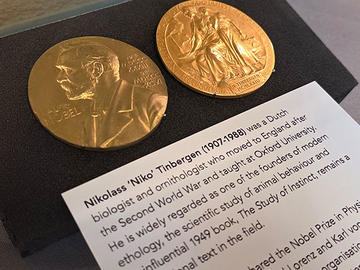
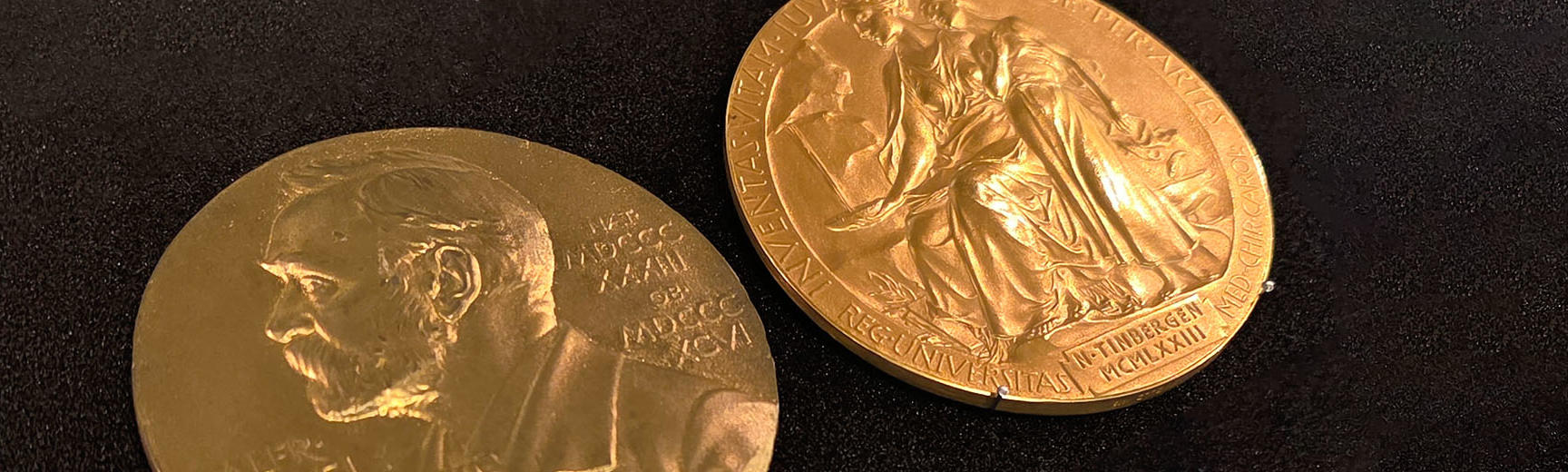
Nikolass ‘Niko’ Tinbergen (1907-1988) was a Dutch biologist and ornithologist who moved to England after the Second World War and taught at Oxford University. He is widely regarded as one of the founders of modern ethology, the scientific study of animal behaviour and his influential 1949 book, The Study of Instinct, remains a foundational text in the field.
In 1973, Tinbergen shared the Nobel Prize in Physiology and Medicine with Konrad Lorenz and Karl von Frisch for their discoveries concerning the organisation and elicitation of individual and social behaviour patterns in animals. Tinbergen’s Nobel Prize medal, along with his other prize medals, were donated to the Museum by the Tinbergen family in 1990. His research and discoveries continue to shape the biological sciences today, and the Museum is proud to care for this remarkable and historically significant object.

