

Molluscs
Molluscs
Molluscs are one of the largest and most diverse groups of animals on Earth. They include snails, slugs, clams, mussels, oysters, squid and octopuses, as well as less familiar animals such as chitons, tusk shells and monoplacophorans.
More than 100,000 species of mollusc have been described. They live in an extraordinary range of environments, from mountains and freshwater lakes to coastlines and the deepest parts of the ocean.
Molluscs also have a very long evolutionary history, with an uncontroversial fossil record stretching back around 500 million years.
The scientific study of molluscs is called malacology, while the study of mollusc shells is known as conchology.
Mollusc is the usual British spelling. In American English, it is usually spelled mollusk.
What is a mollusc?
A mollusc is an invertebrate animal belonging to the phylum Mollusca. Molluscs include familiar animals such as snails, slugs, clams, mussels, squid and octopuses.
Mollusca is the second-largest major group of animals after the arthropods, which include insects, crustaceans and spiders.
Molluscs can look remarkably different from one another. A garden snail, an oyster and a giant squid may seem to have little in common, but all belong to the same major group of animals.
There is also no single visible feature found in every mollusc.
Many molluscs produce shells, but some groups have reduced or completely lost them during their evolution. Slugs and octopuses are familiar examples.
Another feature often associated with molluscs is the radula, a specialised feeding structure bearing rows of tiny teeth. However, bivalves such as clams and mussels do not have a radula, and it is reduced or absent in some other groups.
Molluscs are therefore defined by a combination of anatomical and evolutionary characteristics rather than by one simple feature.
What are the seven main types of mollusc?
Living molluscs are generally divided into seven main classes.
- Gastropoda – snails and slugs
- Bivalvia – clams, mussels, oysters and scallops
- Cephalopoda – octopuses, squid, cuttlefish and nautiluses
- Polyplacophora – chitons, sometimes called sea cradles
- Scaphopoda – tusk shells
- Monoplacophora – deep-sea molluscs with cap-like shells
- Aplacophora – worm-like molluscs including solenogastres and caudofoveates
These groups can differ dramatically in appearance, anatomy and way of life.
Monoplacophorans are a particularly interesting example. They were known only from fossils until living representatives were discovered in 1952.
Examples of molluscs
Molluscs include some of the world's most familiar invertebrate animals.
Examples include:
- the common garden snail (Cornu aspersum)
- the European flat oyster (Ostrea edulis)
- the giant clam (Tridacna gigas)
- the giant squid (Architeuthis dux)
- the colossal squid (Mesonychoteuthis hamiltoni)
Clams, mussels, oysters and scallops are all bivalve molluscs. Snails and slugs are gastropod molluscs, while squid and octopuses belong to the cephalopods.
Some molluscs have evolved into forms that are much harder to recognise.
Shipworms, for example, are not worms at all but highly modified wood-boring bivalves.
Sea angels and sea butterflies are gastropod molluscs that live in the open ocean.
Some tube-forming gastropods resemble worms, while members of the gastropod family Juliidae have evolved shells with two valves and can superficially resemble bivalves.
Female argonaut octopuses construct delicate external cases which they use in reproduction and to help control their buoyancy.
Are snails and slugs molluscs?
Yes. Snails and slugs are molluscs belonging to the group Gastropoda.
However, the word slug does not describe a single natural evolutionary group.
Instead, it is commonly used for gastropods that do not have an obvious external shell.
Different groups of gastropods have independently reduced, internalised or lost their shells during evolution. These include nudibranchs, sea hares and several groups of terrestrial slugs.
This means that slugs have evolved many different times from shelled ancestors.
In taxonomic terms, all slugs are gastropods, but gastropods without visible shells do not form one single closely related group.
Do all molluscs have shells?
No. Not all molluscs have shells as adults.
Some molluscs have lost their shells entirely, while in others the shell has become greatly reduced, internalised or modified.
Slugs are familiar examples of molluscs without an obvious external shell. Aplacophorans have also lost the typical molluscan shell during their evolution, although shelled relatives are known from the fossil record.
Cephalopods show particularly striking variation.
Nautiluses have an external shell. Cuttlefish and many squid retain modified shells inside their bodies. Octopuses have almost completely lost the shell, although some species retain small internal remnants.
Mollusc shells can also become highly specialised.
Some wood- and rock-boring bivalves, for example, use greatly modified shells as boring tools and secrete tubes in which they live.
Where do molluscs live?
Molluscs live in marine, freshwater and terrestrial habitats around the world.
Cephalopods, aplacophorans, chitons, tusk shells and monoplacophorans are predominantly marine. Members of these groups can be found from intertidal rock pools to sediments in the deepest parts of the ocean.
Gastropods and bivalves occur in both marine and freshwater environments.
Gastropods are the only mollusc group to have successfully colonised truly terrestrial habitats, including forests, grasslands, deserts and gardens.
A few molluscs even leave the water temporarily.
Some species of flying squid can propel themselves through the air for short distances.
How long have molluscs existed?
Molluscs have existed for at least around 500 million years.
Possible mollusc-like fossils are known from the Early Cambrian, although the exact evolutionary origins of the group remain debated.
The oldest uncontroversial mollusc fossils are around 500 million years old, and six of the seven living mollusc classes have fossil records extending back to the Early Cambrian.
Scaphopods, or tusk shells, have a shorter uncontroversial fossil record extending back to the Early Carboniferous.
Many mollusc groups known from the fossil record are now completely extinct.
These include Helcionelloida and Rostroconchia, as well as more familiar extinct forms such as the ammonoids, which include ammonites and their relatives.
Other remarkable extinct molluscs include the rudist bivalves, some of which formed large reef-like structures in ancient seas.
Why are molluscs important?
Molluscs play important roles in ecosystems around the world.
They include predators, grazers, filter feeders, burrowers and reef builders, and they contribute to processes including nutrient and carbon cycling.
Molluscs have also been important throughout human history.
People have used them as:
- food
- currency
- dyes and pigments
- jewellery and decoration
- building and manufacturing materials
- musical instruments
- textiles and biomaterials
Molluscs and their shells have also influenced art, architecture, literature, mythology, mathematics and fashion.
Today, molluscs continue to be studied in fields ranging from ecology and evolution to materials science and medicine.
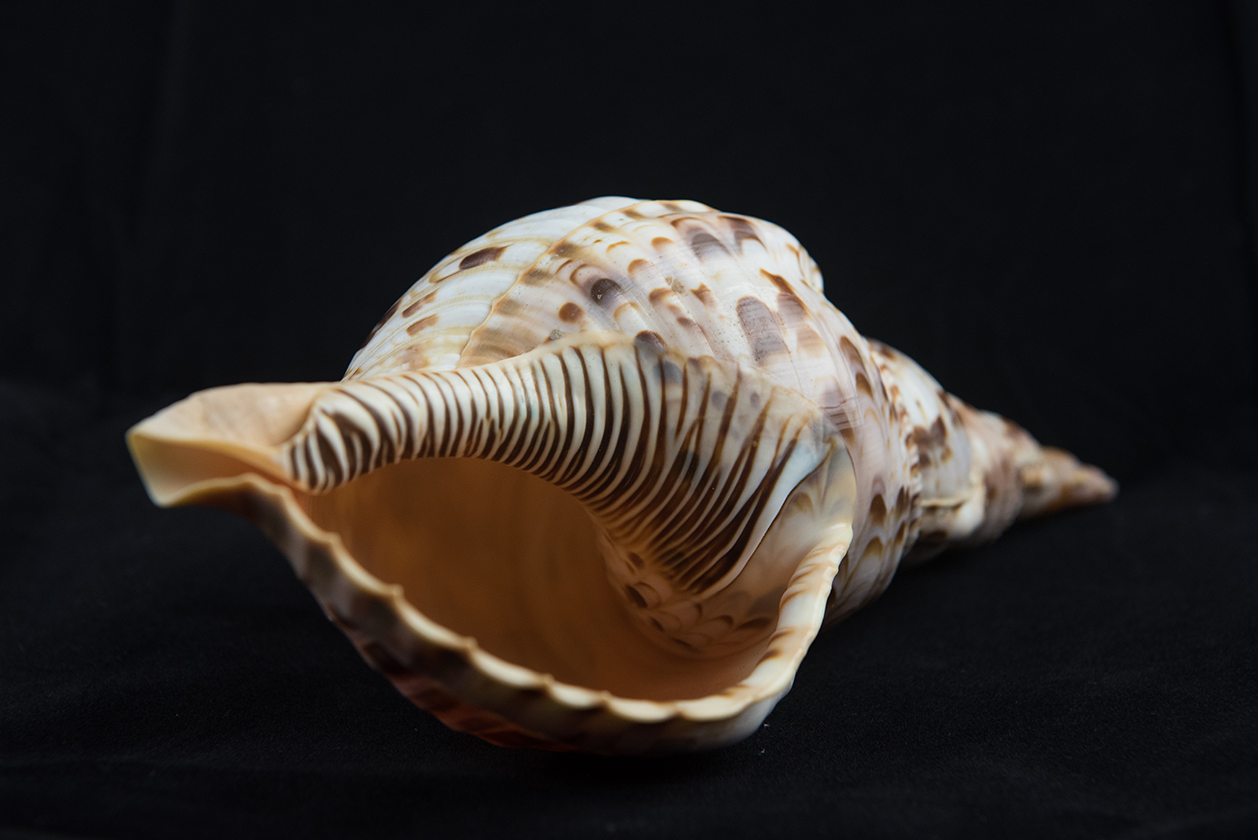
The beautiful shell of a Triton's trumpet (Charonia tritonis).
Molluscs at Museum of Natural History
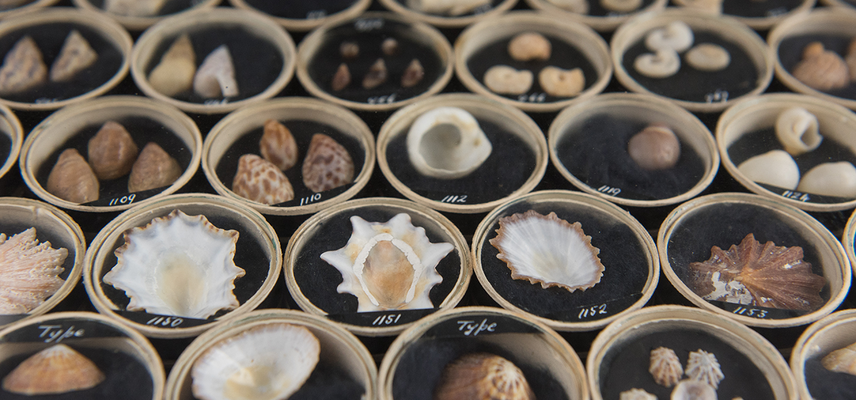
The Museum's mollusc collections are its second-largest collections, containing millions of shells and fossils.
They have played an important role in the taxonomy and scientific study of molluscs.
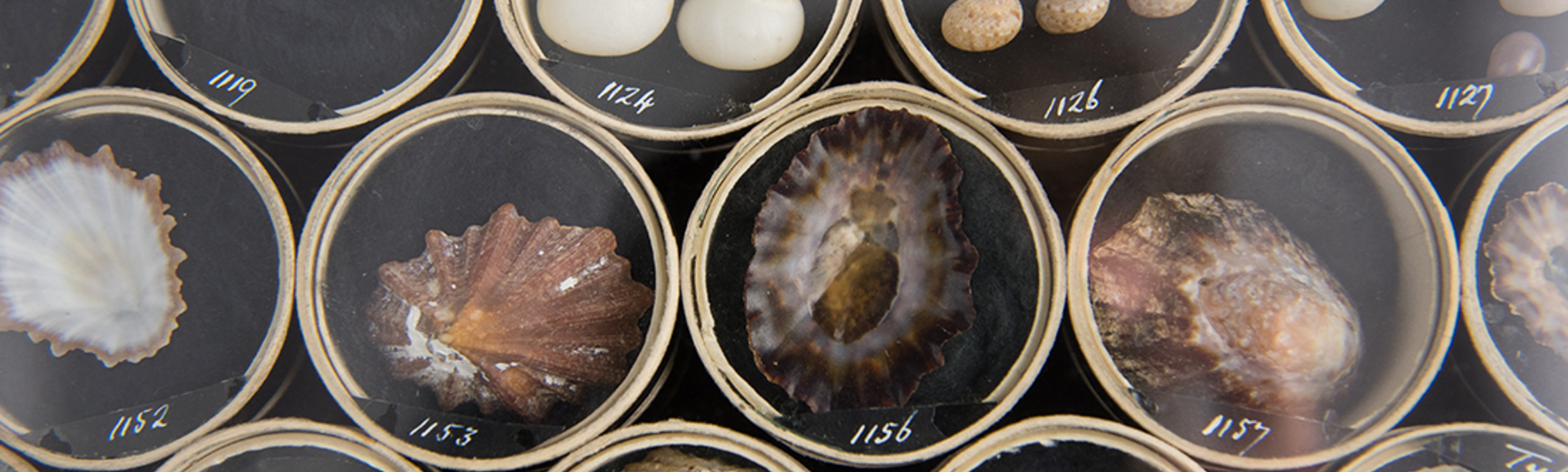
The collections of living and recently living molluscs include one of the largest collections of name-bearing type specimens in the UK. These are specimens used by scientists when species are formally named and described.
The Museum also holds important fossil molluscs, including specimens such as Kulindroplax perissokomos, alongside historically and scientifically significant collections from around the world.
Researchers visit the collections to study subjects including:
- mollusc diversity and taxonomy
- limpet diversity
- Oxfordshire biodiversity
- archaeological and zoological identification
- radiocarbon reference data
- sea-silk production
- potential medical applications of molluscan toxins
The collections are also used as a source of inspiration by artists.
Notable Collectors
One of the most important mollusc collections at the Museum is of marine shells collected from Port Alfred by Turton, W.H. (1856 - 1938). The shells are listed and figured in Turton’s publication The marine shells of Port Alfred, S.Africa,
and the collection contains several hundred type specimens. There are other type specimens in the fluid-preserved and dry collections.
The mollusc collection is comprised of several hundred subcollections: the collections of Sir Walter Trevelyan and Admiral John Harvey are two of the largest, in addition to the material transferred from the Ashmolean Museum and Christ Church in
1860. Smaller collections include those of D Baden-Powell, S D Bairstow, G Barlee, W Burchell, A J Cain, JC and C W Dale, W T Elliott, Eton College Museum, A P Gardiner, L W Grensted, G D Hale, A J Jukes-Brown, E R Lankester, C Napier, F Pascoe, W
H Robson and D Whiteley.
There are also a few specimens from notable collectors Theodore Cantor, Charles Darwin, Revd F W Hope, G W Smith, J R le B Tomlin, W F R Weldon and J O Westwood.
Just over a third of the mollusc collection is currently catalogued and available through Collections Online.
The collection continues to expand. Recent acquisitions of note include specimens of the scaly-foot snail (Chrysomallon squamiferum) and a comprehensive collection of terrestrial and freshwater molluscs from Oxfordshire collected by the
late Arthur Spriggs.
Further Reading and Information
- Beautiful Shells by Mark Carnall
- How to grow a shell
- Argonauts: Astronauts of the Sea
- How the squid got its ink sac
- The beautiful spiral
- Nature’s collectors
- Presenting… The Many Ways of Being a Limpet
- Presenting... Perfect Pens
- Presenting... Problem snails
- Drawn to Nature: Nautilus
- Brasier collections: molluscs